What Happens When a Freight Load Is Rejected at a Distribution Center?

When a distribution center (DC) rejects an inbound freight shipment, the receiver formally declines to take custody of the cargo. This refusal immediately halts dock operations, leaving the commercial carrier in possession of freight that cannot be unloaded as planned.
The core sequence of events unfolds rapidly:
- Dock workers or automated intake scanners detect a defect, damage, or non-compliance issue.
- The receiving manager issues a formal refusal note or marks the Bill of Lading (BOL) as rejected.
- The driver is instructed to pull away from the dock bay, parking in the staging yard or outside the facility gate.
- The driver contacts their carrier dispatch, who alerts the freight broker and shipper to begin exception handling.
The immediate operational fallout is severe. Driver dwell times escalate, throwing off multi-day route plans and disrupting network-wide capacity. According to the American Transportation Research Institute (ATRI), commercial drivers were detained at 39.3% of all stops, losing between 117 and 209 productive hours per year. A rejected load magnifies this dwell time exponentially, as a tractor and trailer can remain immobilized for hours—or days—awaiting disposition instructions.
Resolving a turned-away shipment requires a structured five-stage lifecycle:
- Containment: Keeping the vehicle stationary while confirming the exact scope of the refusal.
- Photographic Evidence Capture: Documenting cargo condition, pallet integrity, temperature readings, and dock circumstances.
- Disposition Determination: Deciding whether the cargo should be reworked, temporarily staged, returned, or redirected.
- Corrective Action & Rework: Performing necessary repalletization, sorting, restacking, or labeling adjustments at an off-site facility.
- Re-Delivery or Secondary Distribution: Securing a new delivery appointment or routing the goods to secondary channels.
Why Do Distribution Centers Reject Inbound Freight Shipments?
Distribution centers operate under strict operational velocity. Inbound intake docks rely on standardized automation, narrow receiving windows, and strict vendor compliance rules. When an inbound shipment introduces safety hazards, manual handling delays, or tracking errors, facility managers will turn the trailer away.
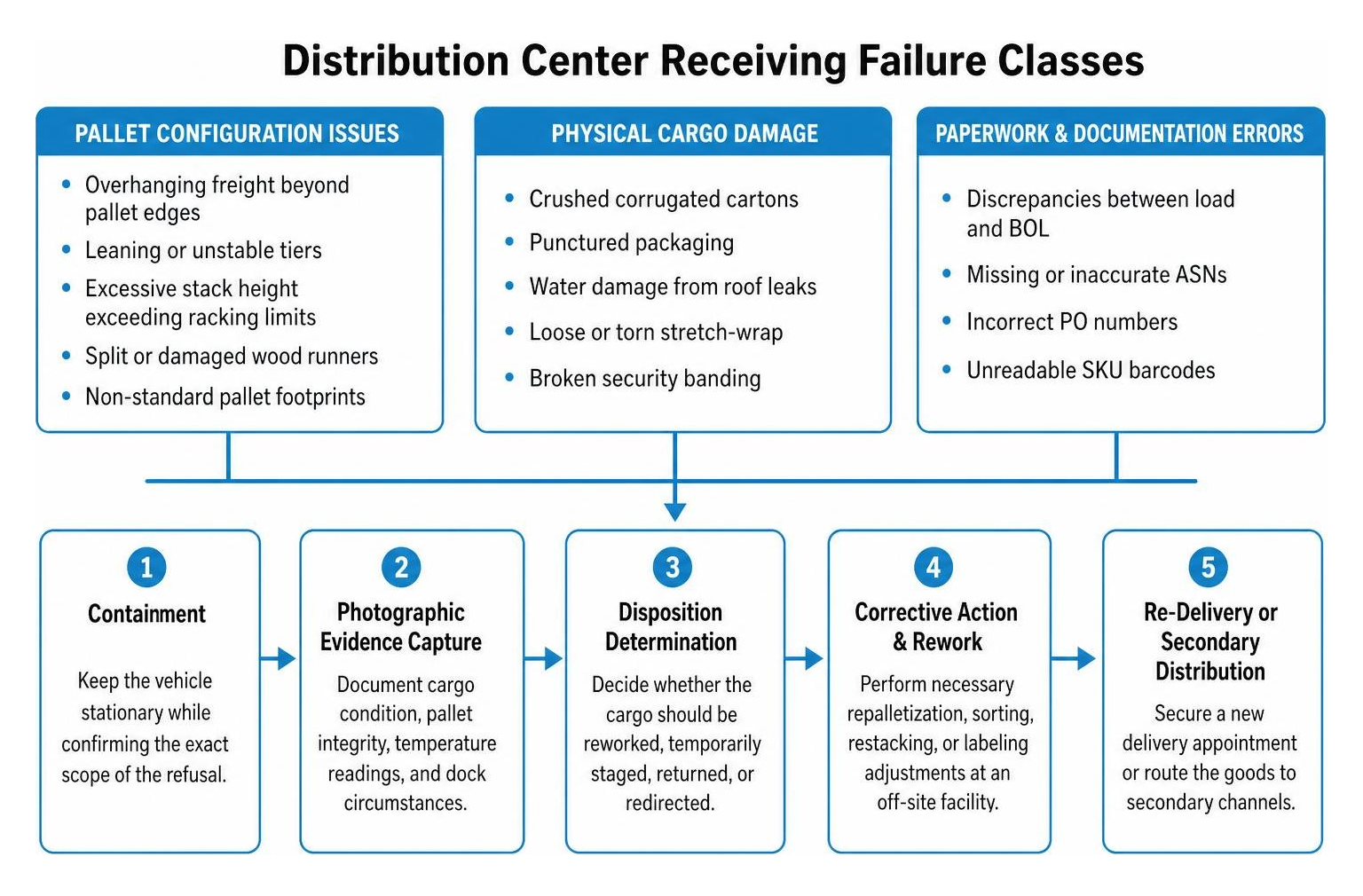
Industry data shows that the vast majority of intake failures fall into five primary failure classes:
- Pallet Configuration Issues: Overhanging freight extending beyond pallet edges, leaning or unstable tiers, excessive stack height exceeding racking limits, split or damaged wooden runners, and non-standard pallet footprints.
- Physical Cargo Damage: Crushed corrugated cartons, punctured packaging, water damage from roof leaks, loose or torn stretch-wrap, and broken security banding.
- Paperwork and Documentation Errors: Discrepancies between the physical load and the BOL, missing or inaccurate Advanced Shipping Notices (ASNs), incorrect Purchase Order (PO) numbers, or unreadable SKU barcodes.
- Temporal Non-Compliance: Missed delivery appointments, arrival outside designated facility grace periods, or unannounced drop-ins without gate passes.
- Sanitary and Temperature Violations: For reefer freight, broken security seals, dirty or odorous trailer interiors, and datalogger records showing temperature excursions outside agreed limits.
Shippers and carriers can prevent these disruptions by reviewing
receiving-compliance checklist standards and adhering to consignee routing guides before freight leaves the origin dock.
Understanding Receiver Tolerance and Vendor Compliance Rules
Different facilities enforce varying degrees of intake strictness. Big-box retailers, grocery distribution hubs, and high-velocity fulfillment centers have virtually zero tolerance for non-compliance compared to general manufacturing warehouses. Automated sorting systems and automated storage and retrieval systems (ASRS) require millimeter-accurate pallet profiles; a single inch of product overhang or loose plastic wrap can jam high-speed conveyor lines.
Furthermore, dock safety standards strictly forbid warehouse personnel and third-party lumpers from manually unloading leaning or structurally compromised pallets. If a forklift operator cannot safely engage a pallet from the trailer bed without risking carton collapse, the load is turned away immediately.
What Legal Rights and Financial Liabilities Apply When Freight Is Refused?
Under commercial transport law and standard uniform commercial codes, a consignee has the legal right to inspect freight upon arrival and refuse delivery if the cargo is non-conforming, substantially damaged, or delivered outside agreed contractual parameters. However, understanding the
legal rights and consequences of freight refusal is essential for preserving revenue and mitigating financial loss.
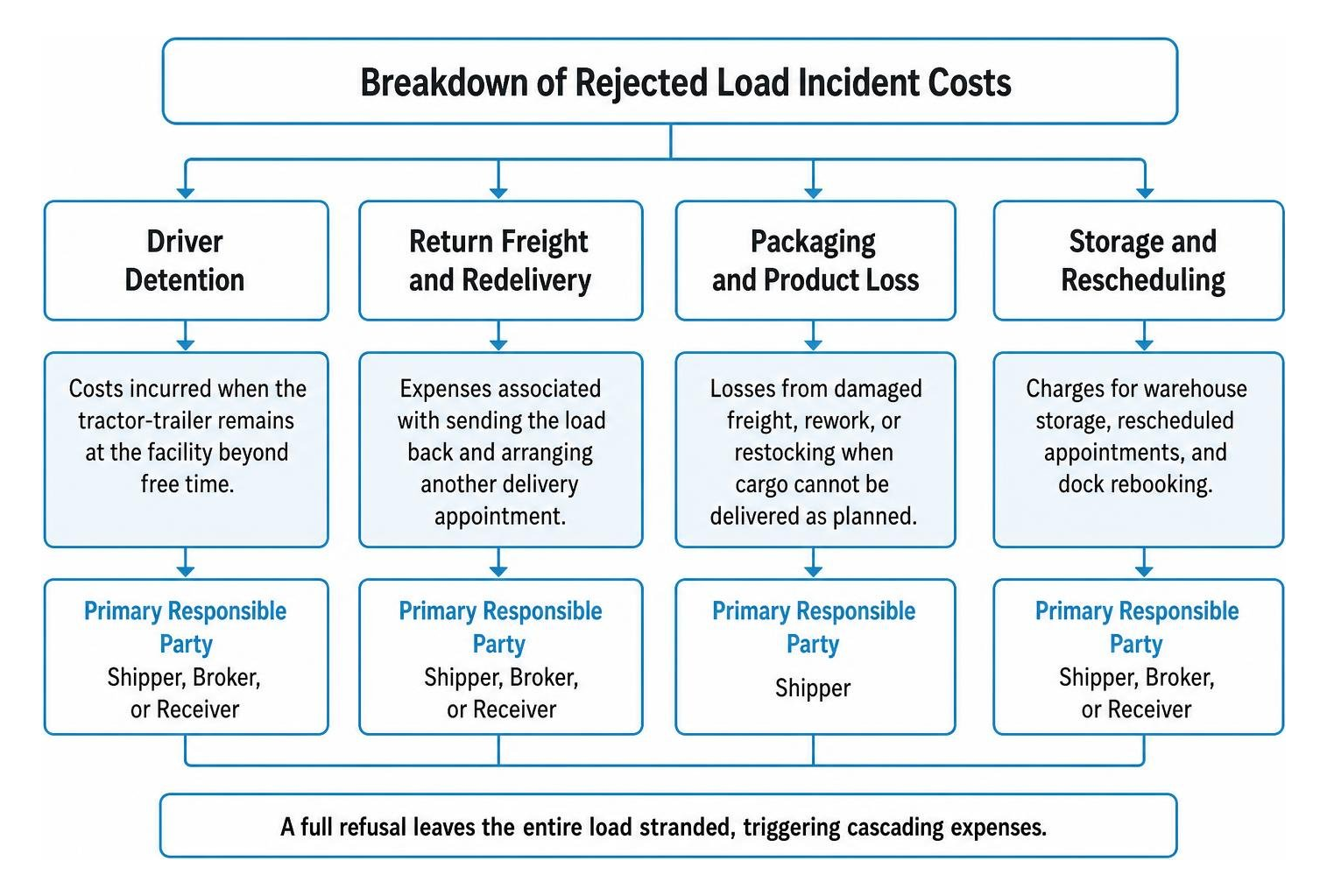
Consignees are legally expected to accept conforming portions of a delivery whenever reasonable. A partial acceptance—where the receiver takes undamaged pallets and marks the damaged units on the delivery receipt—is often preferred because it contains costs. A full refusal leaves the entire load stranded, triggering cascading expenses:
| Expense Category |
Typical Cost Impact |
Primary Responsible Party |
| Driver Detention |
$50 – $100 per hour (after 2 free hours) |
Shipper, Broker, or Receiver |
| Return Linehaul |
Exceeds $500 (often 100% of outbound rate) |
Party at fault (Carrier or Shipper) |
| Pallet Rework & Restacking |
$35 – $75 per pallet |
Shipper or Carrier |
| Short-Term Warehousing |
$25 – $100 per day |
Shipper or Carrier |
| Layover Fees |
$250 – $500 per day |
Shipper or Broker |
When a consignee rejects a load without valid legal grounds, they may be held liable for secondary transport and storage fees. Conversely, if the carrier caused the damage through improper securement or thermal neglect, the carrier’s cargo insurance must absorb the claim.
Bill of Lading Notations and Cargo Claim Defenses
The Bill of Lading serves as the definitive legal receipt and contract of carriage. If a load is turned away, the driver must never leave the facility without an explicit written notation from the receiving clerk.
Receiving personnel must detail the exact “Over, Short, and Damaged” (OS&D) reason on the delivery receipt, complete with date, timestamp, and an authorized signature. Vague notations like “Refused” without context invite contested claims. Under the Carmack Amendment, carriers must prove freedom from negligence; maintaining a clear chain of custody and contemporaneous dock documentation is vital to defend against unwarranted cargo claims.
The first sixty minutes following a dock refusal—the “golden hour”—dictate whether the incident is resolved efficiently or turns into an expensive dispute.
Drivers and dispatch teams should follow this incident-response sequence:
- Halt Movement: The driver must stop unloading, secure the vehicle in the facility staging area, and immediately notify dispatch. Do not leave the premises without instructions.
- Photograph Everything: Capture high-resolution, time-stamped images of the freight inside the trailer, showing pallet conditions, bulkhead positions, load locks, floor conditions, and intact security seals.
- Obtain Written Exceptions: Secure a signed BOL or dock refusal slip detailing why the load was rejected.
- Notify the Broker and Shipper: Dispatch must alert all stakeholders in writing, providing the refusal reason and photographic evidence.
- Secure Revised Rate Confirmations: Before moving the truck to a secondary facility, ensure a revised rate confirmation is issued to cover additional mileage, detention, and layover hours.
For temperature-controlled cargo, immediate actions are critical. Dispatchers must consult protocols for
managing cold chain dispatch after refusals to download reefer datalogger reports, verify continuous temperature integrity, and confirm the unit remains powered and fueled.
Establishing a Coordinated Refusal Response Team
Handling a turned-away load requires real-time coordination between the carrier, broker, shipper, and consignee. Freight brokers play a pivotal intermediary role, securing disposition instructions from the vendor while managing receiver expectations.
Dispatchers must continuously monitor driver Hours of Service (HOS) limits. A driver stuck at a receiving dock risks running out of available drive time, stranding the equipment. Standard operating procedures prevent unauthorized deadhead movements or cargo abandonment by routing the truck to an approved regional facility before HOS violations occur.
What Are the Most Effective Recovery and Rework Options for Refused Freight?
Once a shipment is turned away, stakeholders must evaluate recovery pathways based on cost, product type, and proximity to specialized warehousing facilities:
| Recovery Strategy |
Best Used For |
Operational Advantage |
Primary Drawback |
| Pallet Rework & Restack |
Leaning, shifted, or over-height pallets |
Corrects compliance flaws for fast re-delivery |
Requires a nearby facility with available labor |
| Emergency Cross-Docking |
Unloading freight to release carrier equipment |
Frees driver and trailer for subsequent loads |
Incurs transloading and handling fees |
| Temporary Warehousing |
Awaiting shipper disposition or new POs |
Stops truck detention and layover costs |
Daily storage fees ($25–$100/day) |
| Return to Origin (RTO) |
Wrong product shipped, severe total damage |
Returns goods to shipper inventory control |
Expensive return linehaul (typically $500+) |
| Secondary Salvage / Liquidation |
Product intact, primary receiver cancelled PO |
Recovers partial value, avoids total loss |
Discounted cargo recovery value |
When freight encounters intake failures along major transportation lanes, local logistics hubs provide essential intervention. Our team at
Derby Logistics regularly supports carriers and shippers facing dock rejections with nationwide full-truckload transportation, cross-docking, transloading, pallet restacking, and warehousing solutions that quickly resolve intake discrepancies and keep supply chains moving.
Managing Temperature-Sensitive and Perishable Freight Dispositions
Perishable and cold-chain rejections require immediate action. The USDA Economic Research Service estimates that $161.6 billion of food goes uneaten annually at retail and consumer stages, with roughly 30% of fruit and vegetable losses occurring at farms and pre-retail distribution points.
When perishable goods are turned away, every passing hour increases spoilage risk. Shippers must comply with the FDA Sanitary Transportation Rule and FSMA Rule 204 traceability guidelines. If the primary receiver will not accept the freight due to minor administrative issues, the load must be diverted immediately to compliant cold-storage facilities, secondary food liquidators, or regional food banks before shelf-life deterioration forces certified disposal.
How Can Shippers and Carriers Prevent Load Rejections Before Dispatch?
Eliminating dock rejections requires strict quality control at the origin loading facility before the trailer doors are closed and sealed.

Proactive prevention strategies include:
- Pre-Shipment Quality Audits: Inspecting pallet integrity, stretch-wrap thickness, and corner board placement before loading.
- Standardized Pallet Tier Diagrams: Providing warehouse staging crews with strict stacking patterns that eliminate overhang and enforce height limits.
- Electronic Data Interchange (EDI) Validation: Cross-checking EDI 856 ASNs, physical bills of lading, and customer PO numbers to eliminate clerical discrepancies.
- Active IoT Telematics Monitoring: Pre-cooling reefer trailers to required setpoints before loading and monitoring real-time sensor feeds throughout transit.
- Appointment Re-Verification: Confirming delivery windows, special receiving instructions, and dock equipment requirements 24 hours prior to arrival.
Building a Proactive Vendor Compliance Culture
Shippers should review retailer and distributor routing guides quarterly, as major distribution networks update their intake parameters, barcode symbologies, and pallet specifications regularly.
Carriers must also train drivers to conduct thorough pre-trip freight inspections. Verifying that dunnage bags, load locks, and straps are properly tensioned prevents cargo shifting during sudden stops or turns. Addressing an unstable pallet at the origin dock takes minutes; fixing it after an intake rejection takes days and costs hundreds of dollars.
Frequently Asked Questions About Rejected Freight
Can a consignee legally refuse an entire truckload if only a few pallets are damaged?
Under standard commercial law, a consignee has a duty to mitigate damages and accept undamaged, conforming goods whenever feasible. However, many automated distribution centers enforce all-or-nothing intake rules due to inventory system constraints. When a consignee refuses an entire load over isolated damage, the driver must document the specific number of damaged units on the BOL so the carrier and shipper can segregate the intact inventory at a nearby cross-dock.
Who pays for the extra freight, detention, and storage costs of a rejected load?
Liability depends on the root cause of the rejection:
- If the carrier caused cargo damage through improper securement, transit delays, or reefer temperature mismanagement, the carrier absorbs the additional costs.
- If the shipper sent incorrect product, mislabeled cartons, or improperly stacked pallets, the shipper is responsible for detention, rework, and secondary linehaul.
- If the receiver turned the shipment away without valid cause, the shipper or broker can file for accessorial reimbursement against the consignee.
What happens to rejected refrigerated food shipments that cannot be re-delivered?
When a temperature-controlled food load cannot be re-delivered to the original receiver, the shipper must evaluate disposition options under FDA and FSMA guidelines. If datalogger records confirm continuous temperature compliance, the load is typically diverted to secondary discount grocers, institutional buyers, or food salvage networks. If thermal abuse compromised product safety, the shipment is sent to an authorized facility for certified destruction, supported by formal disposal certificates for insurance claims.
Streamlining Rejected Load Resolution
A rejected freight load at a distribution center disrupts operations, ties up equipment, and threatens supply chain margins. Resolving these exceptions requires rapid containment, thorough documentation, and practical recovery solutions.
By conducting pre-shipment compliance audits, understanding consignee routing guides, and partnering with regional warehousing and transloading specialists, shippers and carriers can minimize downtime and keep freight moving smoothly.

