
Free time is the contractually agreed grace period during which an ocean container can dwell at a marine terminal or depot without incurring penalty fees. Think of it as temporary storage built into your base ocean freight rate.
At major US container hubs—such as the Port of Houston, Los Angeles/Long Beach, New York/New Jersey, Savannah, and Charleston—standard free time for import dry containers typically spans
3 to 5 calendar days. For export containers waiting to load onto a vessel, free time usually extends slightly longer, ranging from
3 to 7 calendar days.
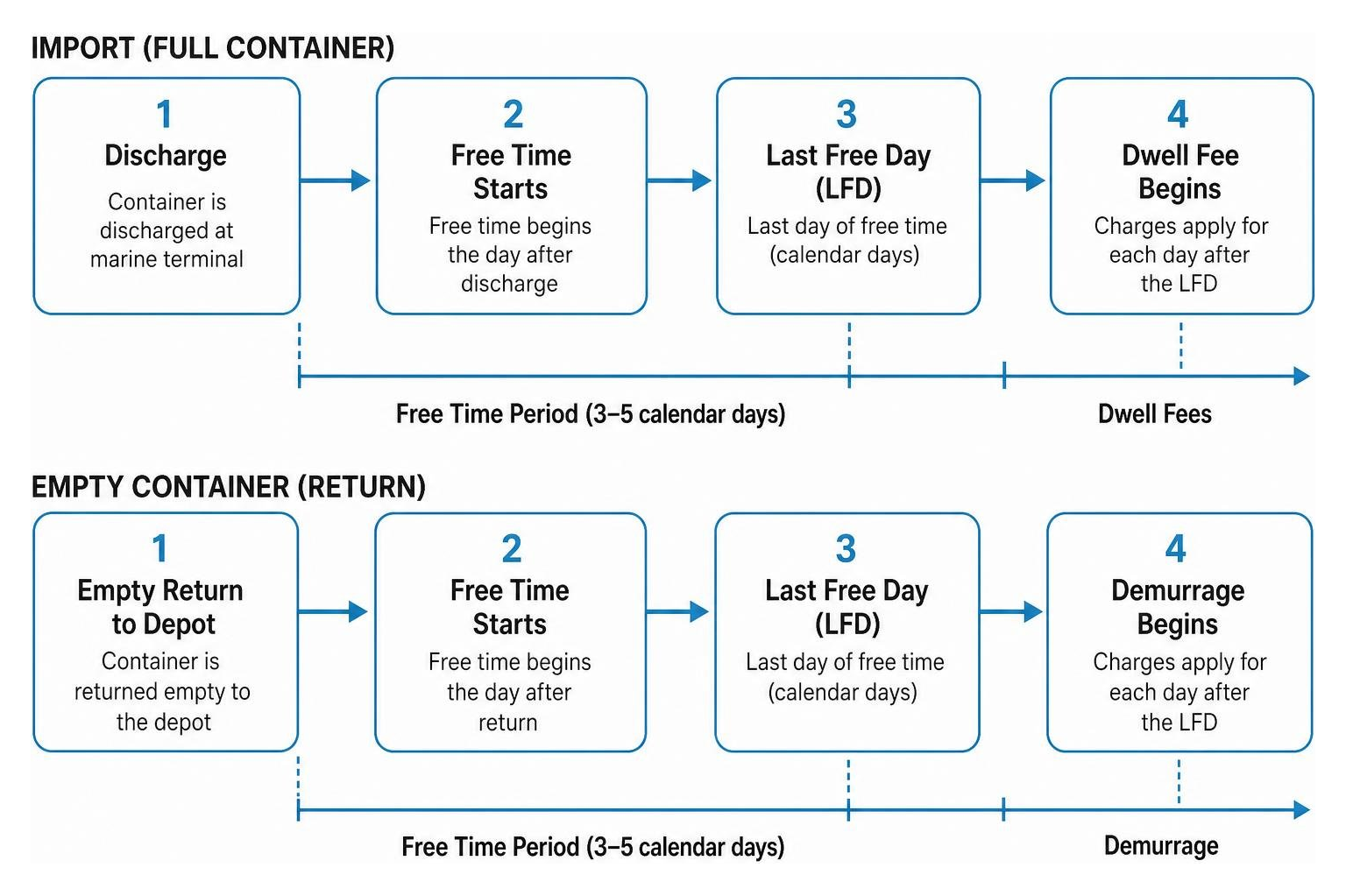
Calendar Days vs. Business Days: The Weekend Trap
One of the most common oversights we see cargo owners make is assuming free time follows standard business days. At most US marine terminals, free time is calculated in
calendar days.
If a vessel discharges your container on a Thursday morning and the terminal grants 4 calendar days of free time, your “Last Free Day” (LFD) is Monday. Saturday and Sunday count against your allotment, even if the terminal gates operate on reduced weekend hours or close entirely. If your customs broker, drayage carrier, and receiving warehouse are closed over the weekend, you lose half your operational window before work resumes Monday morning.
When Does the Clock Start and Stop?
Understanding the exact triggers for free time prevents costly billing misunderstandings:
- Import Clock Start: The free time clock begins upon container vessel discharge and physical cargo availability (the moment the terminal clears the box for pickup and mounts or stages it in an accessible yard block).
- Import Clock Stop: The demurrage clock halts the moment a drayage trucker gates out of the terminal with the laden container on chassis.
- Export Clock Start: Begins when the shipper or drayman picks up an empty container from the ocean line’s depot.
- Export Clock Stop: Halts when the laden export container gates into the marine terminal before the vessel cutoff time.
Factors That Shorten or Extend Baseline Free Time
Not all cargo receives standard dwell allowances. Several variables dictate your actual free time window:
- Equipment Type: Specialized equipment receives significantly less free time. Standard dry vans (20ft, 40ft, 45ft) generally get 3 to 5 days, while refrigerated containers (reefers), open-tops, flat racks, and hazardous material (hazmat) shipments are often restricted to 2 to 3 calendar days due to specialized terminal power (reefer plugs) and strict safety regulations.
- Terminal Operating Tariffs: Individual port terminal operating systems (TOS) maintain local demurrage rules that override broader ocean line terms unless superseded by private service contracts.
- Shipper Volume Contracts: High-volume Beneficial Cargo Owners (BCOs) can often negotiate extended dwell terms directly into their annual service agreements.
For a detailed analysis of operational standards across individual US hubs, review the guide on
Container Demurrage and Detention Fees: How to Avoid Them at US Ports (2026) — FreightFigures.
How Do Demurrage, Detention, and Storage Fees Differ?
The terminology surrounding accessorial port charges can be confusing. Shippers frequently conflate demurrage, detention, and terminal storage, but each fee represents a distinct phase of the supply chain, a specific geographic location, and a different billing entity.
- Demurrage (Inside the Port): Charged by the ocean carrier when a full import container sits inside the marine terminal beyond the allowed free time. It compensates the shipping line for equipment tied up inside the terminal and encourages rapid evacuation of the yard.
- Detention / Per Diem (Outside the Port): Charged by the ocean carrier when you pull the container out of the terminal gate but fail to return the empty equipment to the designated ocean depot within the allotted return window (typically 3 to 5 working days).
- Marine Terminal Storage: Billed directly by the marine terminal operator (rather than the ocean shipping line) for physical real estate use when a box exceeds port storage rules. In some contracts, terminal storage and ocean line demurrage are consolidated; in others, they appear as separate line items.
- Chassis Per Diem: Billed by chassis leasing pools or equipment providers (typically $25 to $45 per day) for the daily rental of the chassis frame used to move the container over the road.
Understanding these distinctions is essential for assigning operational accountability, as highlighted in
Demurrage and Detention Charges Explained | Suaid Global.
| Fee Type |
Location of Container |
Billing Entity |
Trigger Condition |
Typical 2026 Daily Rate Range |
| Demurrage |
Inside the marine terminal / port railhead |
Ocean Carrier (Shipping Line) |
Container not picked up before Last Free Day expires |
$75 – $350+ / day (escalating) |
| Terminal Storage |
Inside the terminal yard |
Port Authority / Terminal Operator |
Cargo occupying physical yard real estate past limit |
$50 – $200+ / day |
| Detention (Per Diem) |
Outside the port (warehouse, road, staging yard) |
Ocean Carrier |
Empty container not returned to depot within window |
$50 – $275+ / day |
| Chassis Per Diem |
Anywhere under the container |
Intermodal Chassis Pool / Leasing Firm |
Chassis equipment retained past daily free terms |
$25 – $45 / day |
How Much Do Daily Port Demurrage Fees Cost and Escalate?
Demurrage charges are intentionally designed as punitive penalties rather than static storage fees. To force containers out of crowded port gateways, shipping lines utilize
tiered escalation rate structures. The longer a container sits abandoned or delayed at the dock, the higher the daily charge becomes.
The Tiered Escalation Structure
While precise figures vary by carrier and terminal tariff, standard 2026 demurrage rates across major US ports generally follow this multi-tier model:
- Tier 1 (Days 1–5 over free time): $75 to $150 per container per day
- Tier 2 (Days 6–10 over free time): $150 to $250 per container per day
- Tier 3 (Days 11+ over free time): $250 to $500+ per container per day
Specialized containers—especially refrigerated reefers—face even higher rates, often starting at $250 per day in Tier 1 and climbing well past $600 to $800 per day in subsequent tiers due to continuous power draw and terminal monitoring.
Financial Impact: The 14-Day Dwell Scenario
To illustrate how quickly delays can destroy freight budgets, consider a single 40-foot standard dry container arriving at a major US port with 4 free calendar days:
- Days 1–4: Free time window (Cost: $0)
- Days 5–9 (5 days in Tier 1 @ $125/day): $625
- Days 10–14 (5 days in Tier 2 @ $225/day): $1,125
- Days 15–18 (4 days in Tier 3 @ $350/day): $1,400
- Total Demurrage Accrued over 14 chargeable days: $3,150
If an importer brings in a 10-container consignment caught in the same documentation or customs snag, that two-week delay creates a
$31,500 surprise invoice before the cargo ever leaves the terminal.
Regional Port Rate Variances
Demurrage costs differ drastically depending on the geographical hub and regional infrastructure pressure. As detailed in the
Demurrage and Detention Charges: 2026 Cost Guide for Freight | SocialVik Blog, the Port of New York/New Jersey remains among the most expensive hubs globally, averaging
$3,182 in combined demurrage and detention for a container delayed 14 days past free time.
West Coast hubs like Los Angeles/Long Beach closely mirror these high penalties due to dense urban real estate constraints. By comparison, highly automated Asian transshipment hubs like Busan average just
$114 for similar dwell periods. Further context on global port storage policies is available at
Demurrage: Port Storage Fees – HZ CONTAINERS.com.
Why Do Containers Exceed Free Time at Marine Terminals?
Containers rarely sit at the port because an importer simply forgot about them. Demurrage accumulation is almost always the symptom of a broken operational link between customs brokers, steamship lines, terminal operators, drayage truckers, and receiving facilities.
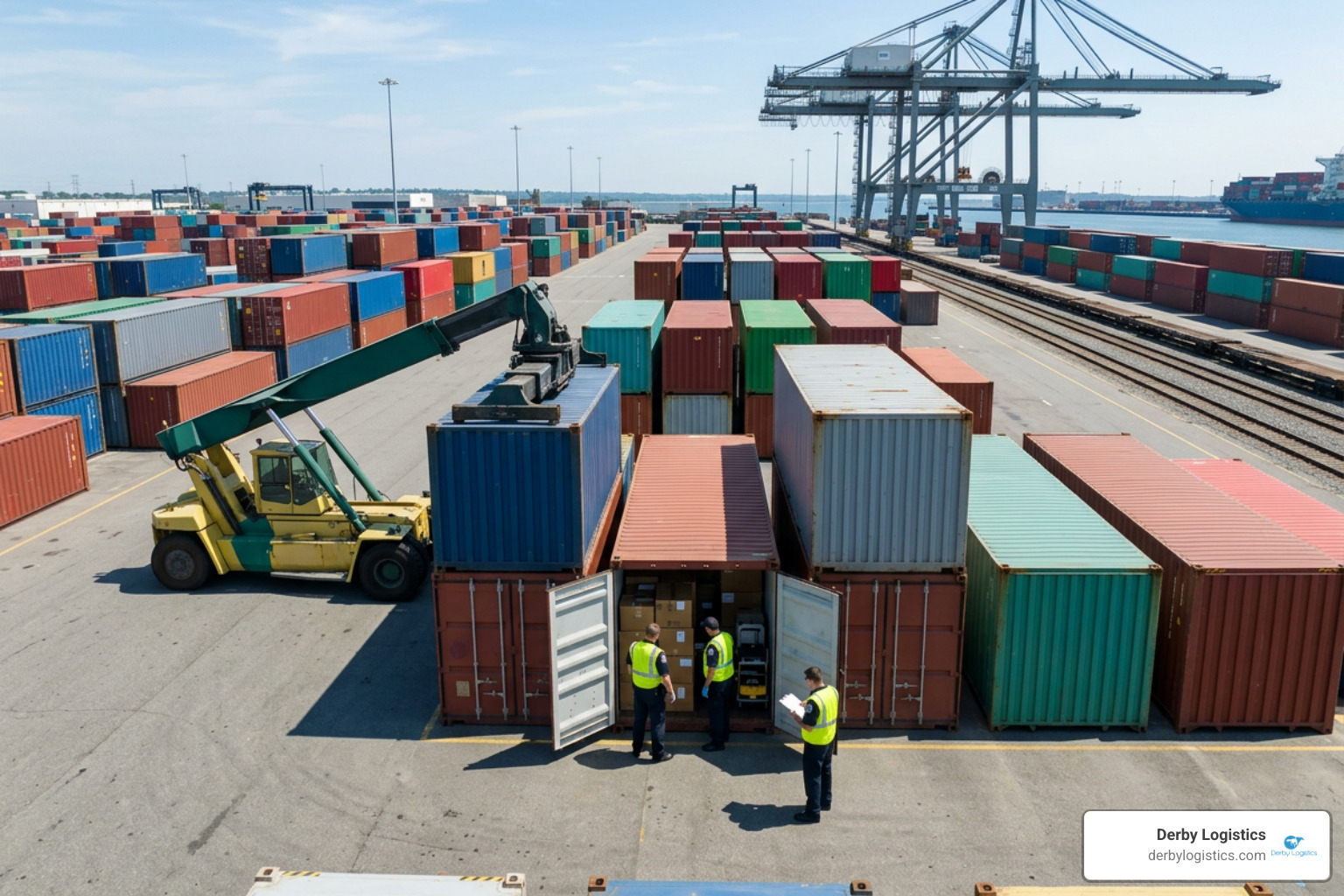
The primary breakdowns that cause containers to exceed their free time window include:
- Customs Examination Holds: US Customs and Border Protection (CBP) or Partner Government Agencies (PGAs like the FDA or USDA) issue intensive holds (VACIS/NII non-intrusive scans, tailgate inspections, or physical devanning at a Centralized Examination Station). While the container is queued for examination, free time continues to tick away.
- Missing or Delayed Documentation: Failure to submit the Importer Security Filing (ISF 10+2) at least 24 hours prior to origin loading, delayed arrival notices, or holding off on releasing original ocean Bills of Lading (B/L) until commercial payments clear.
- Drayage Capacity and Appointment Bottlenecks: Modern marine terminals require truckers to book mandatory gate appointments. If the local drayage fleet faces a driver shortage or terminal appointment slots are fully booked for days, the container cannot be pulled before the LFD.
- Chassis Deficits and Equipment Splits: A drayman may have an open terminal appointment but lack an intermodal chassis to mount the container. If the terminal does not have pool chassis on site, the trucker must perform a “chassis split” (picking up a chassis elsewhere first), adding transit time and cost.
- Receiving Warehouse Bottlenecks: Distribution centers frequently experience full docks, labor shortages, or inventory processing backlogs, preventing them from accepting new inbound container deliveries.
- Port Congestion and Gate Closures: Severe weather disruptions, labor slow-downs, IT system outages, or vessel bunching can stall gate throughput, trapping containers in unreachable terminal stacks.
How Can Shippers Prevent Demurrage Fees and Dispute Inaccurate Charges?
Eliminating demurrage requires a combination of disciplined front-end coordination, flexible local logistics execution, and a clear understanding of federal regulatory billing rights.
1. Pre-Clear Customs Well Ahead of Arrival
Never wait until a vessel docks to file your customs documentation. Customs entries should be pre-filed
5 to 7 days prior to vessel arrival. Ensure all commercial invoices, packing lists, HTS classifications, and PGA declarations are verified and matched against the carrier manifest. Early clearance ensures that the moment the vessel discharges the box, customs holds are already cleared, allowing immediate dispatch.
2. Leverage Near-Port Transloading and Off-Dock Pre-Pulls
When your destination distribution center cannot immediately receive a container, leaving it at the marine terminal is the most expensive mistake you can make.
Instead, execute a
pre-pull to an off-dock secure yard or arrange
near-port transloading. By having a drayage partner pull the container before the Last Free Day, you immediately stop the escalating marine terminal demurrage clock.
At
Derby Logistics, our Houston facilities provide comprehensive cross-docking, transloading, and warehousing support. We can dray containers rapidly from Port Houston terminals, devan and palletize the cargo inside our secure warehouse, return the empty ocean container to the depot within its detention free time window, and deliver the goods nationwide via our full-truckload (FTL) fleet. This breaks the link with carrier equipment and replaces $300/day port demurrage with affordable pallet storage.
3. Maintain In-House CFS Capabilities for Consolidated Freight
For less-than-containerload (LCL) or specialized shipments, Container Freight Station (CFS) delays are a major source of unexpected fees. Utilizing dedicated daily CFS pickups and deliveries ensures your consolidated cargo is de-consolidated and moved without idling in port-adjacent staging yards.
4. Negotiate Extended Free Time in Annual Service Contracts
If your business moves consistent freight volume (typically 50+ containers per year), do not accept baseline carrier tariffs. Work during annual contract negotiations to extend your allowances:
- Target 7 to 10 days of demurrage free time at import destination ports.
- Target 10 to 14 days of equipment detention free time to accommodate regional trucking transits and warehouse unloading schedules.
5. Enforce Federal Invoicing Rules (FMC Final Rule & OSRA-22)
The Ocean Shipping Reform Act of 2022 (OSRA-22) and the Federal Maritime Commission (FMC) Final Rule on Demurrage and Detention Billing (46 CFR Part 541) provide strong legal protections for shippers against improper billing:
- Mandatory 30-Day Invoicing Window: Ocean carriers and marine terminals must issue any demurrage or detention invoice within 30 calendar days of the date charges stopped accruing. An invoice issued after 30 days is legally invalid, eliminating the cargo owner’s obligation to pay.
- Required Invoice Data Elements: Every invoice must clearly include specific identifying data: container number, bill of lading number, vessel name, discharge date, specific dates free time started and ended, the applicable tariff rate rule, and clear instructions on how to submit a dispute. Invoices lacking these required elements can be challenged.
- 30-Day Dispute Window: Shippers have at least 30 calendar days from invoice receipt to submit a formal mitigation request. The carrier must investigate and respond within 30 days.
6. Evidence-Gathering Protocols for Disputing Invoices
If you receive an unjustified demurrage charge due to terminal closures, gate appointment unavailability, or customs holds where physical access was denied, build a verifiable paper trail:
- Save terminal appointment portal screenshots showing “No Appointments Available” prior to the LFD.
- Retain GPS and gate log timestamps from drayage carriers documenting gate turn-aways or terminal delays.
- Keep written records of all carrier communications, customs release timestamps, and equipment interchange receipts (EIR / TIR).
Guidelines on structuring formal carrier disputes and navigating FMC charge complaints are detailed in
Detention and Demurrage: Charges, Who Pays, and Disputes – LegalClarity.
Frequently Asked Questions About Container Port Dwell Time?
How many free days do you typically get for an import container at a US port?
Standard dry import containers typically receive
3 to 5 calendar days of free time at major US ocean terminals. The exact duration depends on the specific ocean carrier’s service contract and the terminal operator’s tariff. Specialized equipment like reefers and hazmat containers usually receive only 2 to 3 days, while high-volume shippers may negotiate 7 to 10 days.
Does a customs examination hold pause the port demurrage clock?
Generally, no. Marine terminals and ocean carriers do not automatically stop the demurrage clock during US Customs (CBP) or Partner Government Agency (PGA) examination holds. However, under FMC interpretive guidelines and the “incentive principle,” shippers can dispute or seek fee waivers if the cargo was completely inaccessible and could not be retrieved due to government mandates outside the shipper’s control.
What is the difference between detention fees and chassis per diem?
Detention fees (often called container per diem) are billed by the ocean shipping line for holding the actual shipping container box outside the terminal beyond the agreed return period. Chassis per diem is a separate equipment rental fee—typically ranging from $25 to $45 per day—billed by third-party intermodal chassis leasing pools for the use of the wheeled chassis frame beneath the container.
What Are the Key Takeaways for Managing Port Container Fees?
Protecting your supply chain from unexpected port fees requires vigilance, proactive communication, and strong local logistics execution:
- Treat 3 to 5 Days as a Firm Deadline: Free time runs on calendar days. Weekends and holidays count against your allotment at nearly every major US port.
- Beware the Escalation Curve: Demurrage rates jump from $75–$150/day in Tier 1 to over $350–$500/day in Tier 3, making multi-day delays exponentially expensive.
- Pre-Clear Everything: Submit customs entries and verify commercial paperwork 5 to 7 days prior to vessel discharge to ensure an immediate green light for pickup.
- Use Transloading to Halt Demurrage: If your destination warehouse is backed up, dray the container out to a local cross-dock facility, unload the goods, and return the empty container before fees start.
- Know Your FMC Billing Rights: Hold ocean lines accountable to the 30-day billing timeline and required invoice data fields under current FMC regulations.
Managing port dwell time effectively comes down to having reliable, responsive partners on the ground. Whether you need daily CFS coordination, rapid port drayage through Houston, specialized freight handling, or off-dock transloading and nationwide dry van transport, we help shippers streamline terminal dwell and eliminate demurrage risk from their balance sheet. Reach out to our logistics team today to keep your containers moving.

